 |
| Colchester's very creepy gaol |
Tourist boards, especially ones for such historical towns, like to make the past something a little fluffy, a little sweet and not too gory. It's the 'National Trust' effect almost, making things very involveable and relatable to current modern life. I like the interactive element of this, but it does tend to mean that we brush over a lot of the uglier aspects to historical life in order to make them appealing to moderners.
Unfortunately for Colchester, a lot of its history comes from events that are not just 'not pretty' - they're downright bloodthirsty. The gaol in Colchester Castle is just one small example of this. Though the whole castle was originally used as a prison from 1226, its military use slowly diminished, and eventually in 1350 the dungeons were converted to be used as the county gaol. Enormous wooden beams surround the door to the gaol still, worn smooth by the endless rubbing of hands from prisoners dragged inside, and graffiti can be seen all over the wood and walls. The cells are tiny, and even more so when you consider that they were crammed with perhaps half a dozen people or more all at the same time. The whole area is terrifically atmospheric, and rumours of prisoner's ghosts abound, further enhanced by occasional charity 'sleepovers' in the dungeons by local political campaigners and spokespersons. One particular ghost story associated with Colchester castle is of Quaker prisoner James Parnell, who was forced to climb a rope every time he wanted to eat, and subsequently fell to his death. According to legend, he now haunts the Castle dungeons, and apparently people who have stayed the night have later emerged complete wrecks.
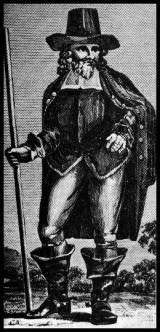 |
| Matthew Hopkins |
The gaol's most infamous inhabitants were mostly down to one man; Matthew Hopkins, the 'Witchfinder General'. Though never a name officially conferred on him by Parliament, Hopkins was the scourge of East Anglia in the early 1640s, interrogating women suspected of witchcraft and sparking off hunts by just tiny small rumours that grew and grew. Women were not helped by neighbours and family members turning evidence and becoming 'informers to the crown', allowing the accuser to go free if they gave evidence or maleficia against another. Trivial disputes between neighbours turned entire villages against each other, and an animal dying of natural causes before its time could be used as proof of witchcraft by any woman seeking to punish their neighbour for any reason.
In his book 'Witchfinders', Malcolm Gaskill describes Colchester Castle gaol as shown to Matthew Hopkins by the gaoler Stephen Hoy.
The gaoler unlocked an oak door studded with nails, and showed his guest through into a small room where the smell of human waste intensified and sounds of movement and murmuring could be heard. There was no natural light here. Leading off this space were two cells, one for men, the other for women. Opening the door to the women's cell, Hoy held his lantern high to illuminate a tableau of despair.
Through disuse since the 14th century, the castle had fallen into disrepair. The roof had collapsed, the walls were in a terrible condition, and the building was really only fit for its remaining purpose - a prison. Prisoners had no light, space, or sanitation, beaten by the officers watching over them, and often charged for their stay. Felons were shackled, beds were simply bare stone and a bit of straw, and the walls were mouldy, wet and filthy. After a few weeks in these conditions, it was no wonder that so many women confessed, just to ease their pain. In two weeks alone between May and June 1645, four woman died, and according to Gaskill, around thirty women were kept in this one cramped cell. The most likely cause of death was bubonic plague.
The Witchfinder General story is absolutely fascinating, demonstrating how one Suffolk man, the child of a rector in an incredibly superstitious age, sent East Anglia into a terrifying downward spiral of accusation, coersion and suspicion, leading to the deaths of so many innocent women. It's something I'll be returning to over several posts in this blog, hoping to tease out any evidence remaining visible today of the Witch-hunts of the 1600s. The best place to start, however, is deep in the bowels of Colchester Castle, where that nail-studded oak door still remains, and the gaol - much more pleasant to look at now - is a deliciously creepy visit.


